Kolminaisuus
Kun kaksi syntyi, kolmas syntyi, sillä vastakohtien välillä on oltava silta. Syntyi mies ja sen sisko, joka oli lisko. Käärme tuli heidän välilleen. Syntyi vanha maailma ja sitä vanhempi maailma, ja niiden väliin syvä kuilu. Syntyi kaksi vuorta: toinen nousi merestä, toinen paloi maan syvyyteen.
Kun aurinko sai kuun, myös maa rajattiin. Kun oli kaksi, oli aina kolmas. Aina suhde kahden välillä. Näin myös aika oli aina menneen ja tulevan välillä.
Miten näitä kuvajaisia voi tutkia? Jos tutkit yhtä, käännyt pois toisesta. On päästävä peilin pinnalle. On päästävä läpi kuilusta. Tähän tarvitaan neljä kulmaa. Tarvitaan ovi tutkijan ympärille.
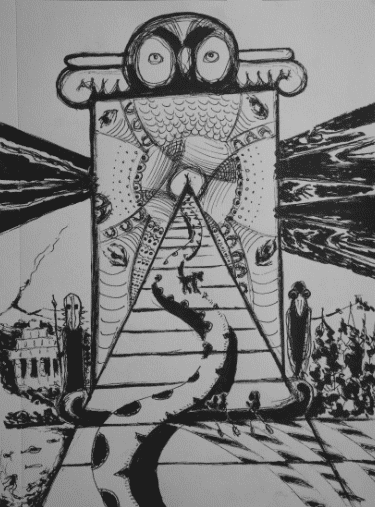
Trinity
When two were born, there was also third, because opposites require a bridge between them. A man was born, a wizard, with a sister, a lizard. A snake came between them. An old world was born and an even older one. A deep chasm between. Two mountains were there: One that rose from the sea, another that burned into the depths of the earth.
When the sun had the moon, earth was also circumscribed. When there was two, there always was the third. Always a relation between the two. Thus there is time also, always between the past and the future.
How can you study these reflections? If you look at one you turn your back to the second. You need to reach the surface of the mirror. You need to navigate the chasm. For this, four corners are needed. A door is required around the investigator.